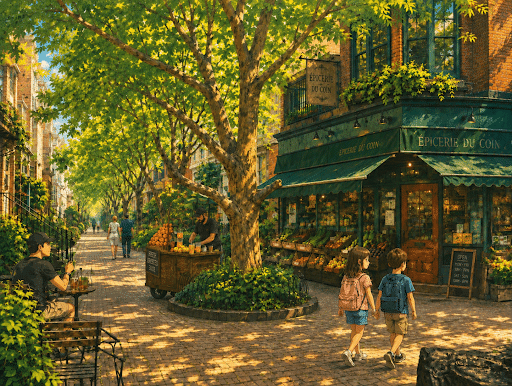
We’re building something that is illegal in the vast majority of urban land in the US and abroad. A place with corner grocery stores, narrow car-free streets, and mixed use buildings. Traditional storefronts that open directly onto the sidewalk, businesses without parking, single-stair apartments, and front yard gardens.
I’m working on a project called Meridia to build a mostly-car-free federated solarpunk micro-city near Austin Texas, designed for social connection and economic freedom. Meridia will have a European-density town center with a blend of architectural and natural beauty conducive to human well-being. Breathable buildings and permaculture will make Meridia healthy and green. And an externality-based governance system will provide light-weight rules that keep Meridia pleasant and functional, combining the peace of the countryside with the vibrancy of the urban core.
Meridia plans to be the first freestead, a free city in America.
What is a Freestead?
A freestead is a place that creates an alternate legal jurisdiction using a citizen contract and existing legal structures. A charter city like Prospera needs to spend years carving out a special economic zone with broad autonomy, even in the best of cases. By contrast, a freestead can skip that difficult first step and jump directly into building a free city without special permission from a government.
A freestead achieves a substantial amount of legal autonomy by using a toolkit of legal mechanisms.

Binding arbitration is an agreement between two parties to use a private arbitration company instead of the usual court system in the case they get into a disagreement. Binding arbitration is a very common practice widely upheld around the world. This allows a freestead to set up an alternate court system from the broken normal court system. Combined with a citizen contract, this can create an alternate ruleset for tort law (non-criminal law). Together, these techniques can substantially improve the fairness, speed, and costs of legal disputes.
Not only could a court case be done over Zoom instead of waiting around in a courthouse, but a fairer system would make people feel more free to do perfectly reasonable things that our over-litigated world discourages. We can have beautiful tree canopies over streets again. Windows in high buildings that actually open. Maybe even fire poles and zip lines in public places. And trees can have low climbing branches and playgrounds can allow risky play with merry-go-rounds, seesaws, and high monkey bars again.
“Better a broken bone than a broken spirit.” ― Lady Marjory Allen
In Meridia, we want to implement externality-based zoning, where we don’t ban businesses in residential places but instead place limits on noise, light, smells, etc. For example, we plan to incentivize circadian-rhythm friendly lightning so the people of Meridia will get good sleep.

We will also allow a by-right ability for buildings to create upper-level bridges over streets so people can have a reliable way to connect upper levels to more activity. We can incentivize people and businesses to provide excellent public spaces so that innovative urban design can come from the private sector instead of central planning.

Tax-rerouting changes who pays what taxes in order to improve economic incentives. In Meridia, the Meridia organization will pay the property tax so land holders aren’t punished for building. Land holders will instead pay a georgist ground rent based on the raw value of their land. This will lead to a denser and more valuable town center with interesting places you don’t just drive to, but can live among. This also aligns long term incentives, since anything that is good for Meridia citizens will raise the land value and result in more revenue for the Meridia organization.
Meridia will give people the by-right ability to build directly on the sidewalk, build buildings that span over the street, and jetty buildings over the path like in old Shambles in England.

Building in regulation-light territory allows a freestead to avoid excessive rules for zoning, building codes, permitting, and other regulations that you find in cities. These are some of the biggest economic distortions in the economy and are serious barriers to the freedom to build on your own land.
In the US and Canada, we have unincorporated territory – county territory that is not within any city or town. For example, over 95 percent of the land area in Texas is unincorporated and you can find unincorporated territory less than a 15 minute drive from downtown Austin. Other countries aren’t so lucky, but “regulation-light” is relative and any country will have places that have less regulation than others.
Meridia will allow mixed-use buildings anywhere. People will be able to build up to their property line so townhouses can be built. You’ll be able to run a business out of your home, including kids legally setting up a lemonade stand. In Texas, kid lemonade stands were illegal in most towns until 2019 when the state legislature passed the Lemonade Stand Bill ensuring that specifically kids can sell specifically lemonade in residential neighborhoods. Most cities ban these kinds of things in about 80 percent of their land area. Austin, for example, only zones about 15 percent of its area to allow mixed-use buildings.
We’ll adopt the spire code pioneered by Seaside, Florida that allows one 14×14 foot area per lot to have no height limit, and as advocated by Wrath of Gnon. You’ll be able to grow productive food in your front yard and productive food will be also grown in streets, something you’ll almost never see anywhere else in the US.

Private streets allow you to control the design of your streets.
Standard street design is a huge part of why public life is so different today than it was 100 years ago. Most land developers build the streets and utilities before handing them over to the town government for long term maintenance, but most towns and cities require huge rights-of-way (street width between plots), wide roads for cars, over-abundant parking, public car access to every lot, etc. These things destroy the walkability and pleasantness of town streets.
Keeping streets private means you have the ability to change these design features. Car free streets are much safer and more accessible, especially for children and the elderly, which is why bike paths and walkways will be the primary transportation network in Meridia.

In Meridia, we also plan to create narrow streets, parking-free streets, streets that double as public squares, and permaculture rain redirection. We don’t plan to get rid of cars entirely, but we believe cars don’t need to be able to drive to every doorstep. Meridia will have a few high-speed high-efficiency roads rather than building low-efficiency stroads everywhere.
Private streets also make hyper-local control and cost-allocation for streets possible. Infrastructure is actually cheaper per person in denser places, and the land value in denser places is almost always higher. Because cities usually maintain infrastructure across the entire city to the same standard, this usually means the wealthy suburbs are being subsidized by poorer areas. In one example in LA, a wealthy suburb that is responsible for building and maintaining their own infrastructure consistently votes down proposals for paved roads because the cost is in the millions of dollars for a simple two-lane road – too high, even for them.
In Meridia, each block will control and pay for its own streets and utilities. That way those who use more expensive infrastructure will be the ones who pay for it, avoiding the inefficiencies often seen in cities with lots of sprawl and allowing the people on an individual street to express their creativity for how the street outside their house looks.

Private streets also allow you to control access: who is allowed to be in your freestead. A freestead might allow anyone in except those who break its laws or it might require a more involved screening process. Day-visitors might be allowed to enter freely, but permanent residents or citizens need to pass a test. Private streets are necessary to enable these kinds of decisions.
Entrance screening is a freestead’s immigration system. In Meridia, we want to build a high-trust society. We want to ensure that citizens agree with the values of the town and respect their responsibility as a citizen.
And the environment in a place with like minded people will inevitably have a lot more attractive options than in a place where most people want things that you don’t. A community of people who don’t want to eat fast food isn’t going to have fast food places. A community where people are doing things out and about in cafes, parks, and other public places provides a much more engaging intellectual and social life than a place where most gatherings are in private.
A community of like minded people is much easier to freely discuss ideas and connect with. Social cohesion also becomes a lot easier as well. A very small percentage of people cause the vast majority of problems. Fewer conflicts, more good experiences.
In Japan, people can leave their bikes unlocked, purses unattended, and set up unmanned honor-system shops. These things are only possible in a high-trust society. Young children walking to school by themselves used to be the norm. It can be again in Meridia.
Supporting a Community
Human connection is sacred.
We live in a world where people are more connected, but feel more isolated than ever. Humans are tribal animals. We need our privacy, but we also need our people. Having a healthy social life also is incredibly important to your health, both mental and physical. Trusting your neighbors makes it possible for people to share resources and cover for each other. You might borrow a neighbor’s stand mixer, ask them to take care of your pet when you’re away, or watch your child when you have a night out. Your neighborhood also becomes safer when your neighbors know when you’re gone and keep an eye out for you. And their company gives you a much richer tapestry of connections in your life.
Meridia will use the freestead toolkit to build a place where strong communities can sprout and thrive. Car free places create safe relaxing places people want to linger in, an attractive built environment gets people out of their house, interesting 3rd places bring people together. Good incentives that make it easy to build the community services and groups that make a town an attractive place to be – things like barbers, a grocery store, restaurants, bars, bakeries, dances, book clubs, etc.
A good legal environment is the base layer that makes trust easier to build. But legal action is always a last resort. A thoughtfully created culture can reduce or eliminate the need for stronger action. Communities often fail because disagreements tear them apart. A strong culture can prevent disagreements from spiraling out of control. Meridia will have a culture of personal responsibility, mature discussion and mediation, and respect.

We have an opportunity to create new traditions, new stories, and better norms. Help us craft a new society! Meridia is still in its infancy, but if you’d like to learn more, visit https://meridia.town. And if you’re interested in reading more about the freestead concept, here is the original and a follow up.
All renderings provided by Meridia.

Billy Tetrud is Meridia’s co-founder and CEO. He has researched and written about governance and economics for 10 years, most recently in his Governology Substack, and is a co-host of the Eco-development & Land Projects meetup in Austin. His life-long passion for invention and futurism lead him to a 15 year career as a software engineer, entrepreneur, and ex-Googler. He has worked in the Bitcoin self-custody space and has written several papers about Bitcoin. He started Tixit, a company that built an extensible project management system. His vision of the future champions smarter libertarian governance and pro-human environments where communities can thrive.