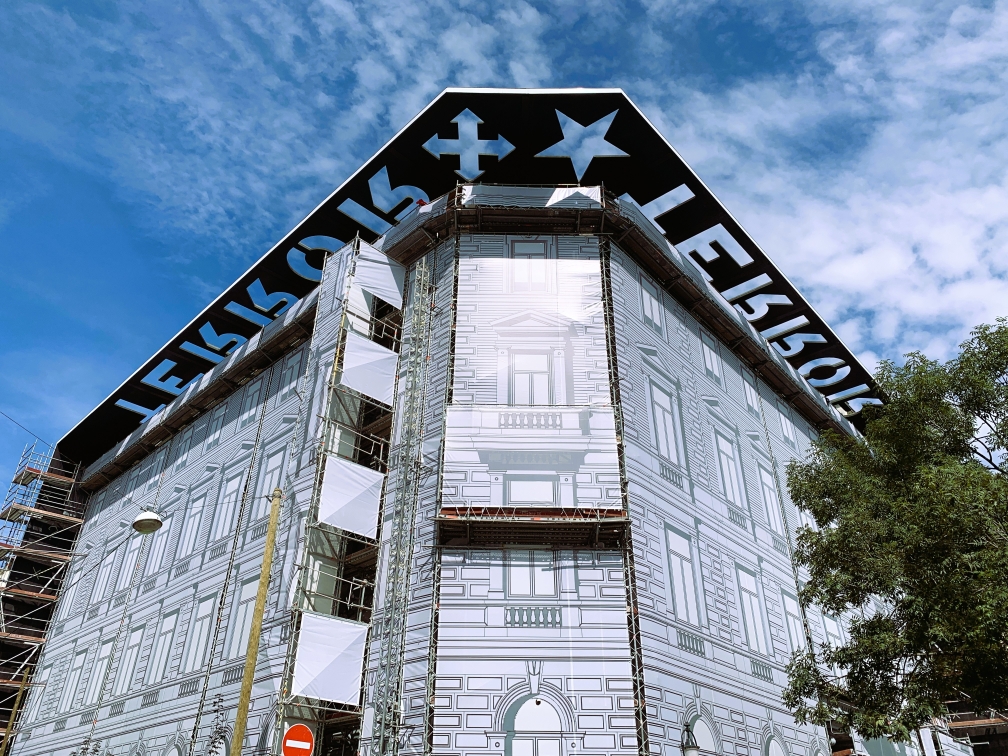
Standing outside the House of Terror in Budapest, I felt the weight of history pressing in. The building, wrapped in grey and half-hidden by scaffolding, seemed as sombre as the stories I’d heard. I looked up, uneasy but curious, and wondered what really happened behind these walls. News and conversations from recent days drifted through my mind, leaving me thoughtful and a bit sad. There’s confusion here, mixed with the sadness that seems to settle over this place.
Visiting the Terror Háza museum, or House of Terror, at 60 Andrássy út., it’s hard to imagine that this building, now a museum, once stood at the center of two of Hungary’s darkest chapters in the last century.
*Note: Some of these links are affiliate links, meaning that if you book through my link, I will make a small commission (at no extra cost to you).
During World War II, Hungary’s alliance with Germany became a heavy burden. At first, Hungary was reluctant to fully serve the Nazis, but any hope of pulling away ended when Nazi Germany occupied the country in the spring of 1944. After that, the Nazis sped up the deportation of Hungarian Jews, opening one of the darkest chapters in Hungary’s history. By the summer of 1944, the Red Army was advancing, pushing out the Nazis—only to stay on as the new occupiers. This was the start of Hungary’s transformation into a Soviet-controlled communist state.
Both occupations brought bitter lessons. Hitler’s Germany accelerated the deportation of Hungarian Jews to labour and extermination camps outside the country. Almost 440,000 Hungarians were transported, most never returned. (United States Holocaust Memorial Museum, Washington, DC, 2025) This wound pains the nation deeply. The communist dictatorship, settling into long-term rule, aimed to radically transform society and plunder the country. Like other Central and Eastern European states, the Soviet Union took Hungary as a war spoil, making it part of the Soviet empire. Hungary remained occupied from 1944 until liberation in 1991. (Terror Háza, 2025)
“Last night I dreamt that the Germans had left and no one came in to replace them.” – Imre Kovács, House of Terror museum
In 1944, the house on Andrássy út, then called the House of Loyalty, was the headquarters of the Hungarian Nazis, known as the Arrow Cross Party, a puppet government installed by Nazi Germany. In 1945, the Hungarian communists, arriving with Soviet tanks, quickly took over 60 Andrássy Boulevard. From 1945 to 1956, the communist secret police, the Department for Political Police (PRO), took over the headquarters, which later became the ÁVO (State Security Office) and later the ÁVH (State Security Authority). 60 Andrássy Boulevard became a place of terror for both regimes. (Terror Háza, 2002)

As we walked closer to the House of Terror, the scaffolding caught my eye. Restoration work seems to be ongoing, a way of keeping history present. A line had already formed at the entrance. We were told that cameras weren’t allowed above the ground floor, to keep the exhibits undisturbed. In the photo above, the cross and arrows represent the Hungarian Nazis, while the star stands for the communist regime.
The House of Loyalty
The head of the Arrow Cross Party declared, “The Andrássy Boulevard headquarters will always remain for me and for the Hungarian popular program, the House of Loyalty.” If you have read 1984, you will notice a similar use of language here.
Teenage boys were forced into hopeless battles for the Nazis. By the banks of the Danube in Budapest, the Arrow Cross shot defenceless women and children, whose bodies were carried away by the river’s icy waters. (Terror Háza, 2025) The Arrow Cross Party’s blind loyalty led Hungary toward destruction as they pushed their socialist agenda with violence.

A sign in one room held an example of a communist membership card to be signed by all those who were members of the Arrow Cross Party. A portion of the card read:
“I want to remedy this mistake, and I pledge with all my time and total strength, I stand ready to fight for the people’s democracy.”
The mistake: to be a member of the Hungarian Nazi party.
The Nazis who remained and were now pledging loyalty to the new communist party changed their racist theory for the theory of Marxist class struggle; it was a matter of changing uniforms. However, these shifts were not always voluntary or straightforward. Motivations were complex, often driven by the pressures of survival in a rapidly changing political landscape. Many individuals found themselves coerced into new allegiances, navigating a treacherous path to align with the dominant ideology. The fear of retribution, loss of status, and the quest for personal safety often forced people to adopt new ideologies, even if it meant betraying their former beliefs.
And what does “fight for the people’s democracy” mean?
Politicians often use the word democracy to claim to defend people’s rights. In Hungary’s first free elections in November 1945, the Communist Party received only 17 percent of the vote. By 1949, they claimed 95.6 percent. (Kovrig, 1979) Communism then ruled for forty years. These numbers did not just happen; they were the result of fear and control by the Communist Party. Elections weren’t about real choices, but about following what the regime wanted. Propaganda was everywhere, making it dangerous to disagree. Much like Orwell’s Newspeak in 1984, where language was twisted to prevent subversive thought, terms like ‘people’s democracy’ masked coercion and manipulation. Picture a man, waiting in line to vote, feeling pressure to choose what was expected. For him, voting wasn’t just about politics; it was about staying safe in a place where speaking out could have serious consequences.

Every Wall Had Eyes
Informers, a shadow army, watched people on factory floors, in editorial rooms, in offices, in universities, in churches, and in theatres. Every move was noted. The informers received full backing as well as ideological and practical guidance from the Soviet occupiers. No one was safe. It was with the informers’ support that the Communists came to power, built and preserved their tyrannical regime. (Terror Háza, 2002)
The population was reduced to subjects. Thousands of citizens feared the informers, and then, in turn, they feared each other. If ordered to do so, they killed without hesitation, or on the strength of confessions extorted during brutal interrogations. Under the pain, people were ready to sign any document. Victims were sent to the gallows, prisons, and labour camps.
Officers serving at 60 Andrássy Boulevard were masters of life and death. The motto of the ÁVO guards was “Don’t just guard them; hate them too.”
Months after moving in, the communist organisation outgrew the headquarters and began to expand, occupying the entire block. The cellars under the buildings were connected to form an underground labyrinth of prison cells.
As I walked through the museum, I saw many videos of former victims, their families, and old propaganda films. Watching the films made by the Nazis and the Communist Party was revealing. Crowds gathered in squares, clapping together automatically, as if they were under a spell, making the sense of control and manipulation feel even stronger.
As stated in the commentary of the videos, “Happy Hungarian children” carrying large flags emblazoned with images of Stalin and Lenin at the forefront rushed into masses of people to parade the flag around, waving arms, and throngs of people cheered them on. Two children took a bouquet to the Communist leader of Hungary, Mátyás Rákosi, who took the flowers and then kissed each child.
Walking through the museum, I came across a hallway where the walls looked like blocks of pork fat. The rubbery bricks were meant to remind visitors of lard, which became a symbol of hardship in Hungary during the early communist years. In the 1950s, many families survived on bread with lard—simple, filling, and a reminder of tough times. It wasn’t just Hungary; people across Eastern Europe, from East Germany to Romania, faced the same shortages and long lines for basic things. The whole region shared this struggle under Soviet rule.
Down in the cellar of the House of Loyalty, it’s hard to ignore the sour, damp smell that lingers in the air. This is where members of the Arrow Cross and communist parties tortured and killed hundreds. The atmosphere is heavy, and it’s impossible not to feel the weight of what happened here.
At the end of the museum, I stepped into a red room filled with small photos, each one surrounded by images of those who caused so much suffering. None of these victimizers were ever brought to justice, so this hall stands as a way to remember and, in some small way, to set things right.

Now, 60 Andrássy Boulevard is a monument to the victims. The house demonstrates today that sacrifices made in the name of freedom are never futile. From the fight against the two murderous regimes, the powers of freedom and independence have emerged victorious. However, the journey towards justice has been complex.
Following the fall of communism, Hungary faced the delicate task of addressing the criminal acts of the past. Various efforts were undertaken, such as truth commissions aimed to shed light on the atrocities and debates on how to hold perpetrators accountable. Trials for those involved in political crimes were carried out, though many went unpunished, raising questions about the adequacy of these judicial measures.
Lingering questions remain: what does justice look like when perpetrators go unpunished? As visitors leave the haunting final red room, they are compelled not just to remember, but to engage with the moral accounting of history and their role in shaping justice today.

Applying the Past to the Present: Lessons from the House of Terror
I notice similarities between the museum’s history and some situations today. These include changing definitions of words, loyalty to political parties, attacks on freedom of speech, restrictions on religious and personal freedoms, lack of accountability among leaders, and even regional changes such as health regions renaming themselves to Health Authorities. For instance, recent changes in how certain terms are defined in political discourse often echo the language manipulation seen in the past. A recognizable example is the increasing controversy over social media platforms moderating content, which mirrors historical suppressions of free expression. Recent legislation in some countries regarding restrictions on protest or religious gatherings highlights how these themes continue to manifest today. These examples serve as a reminder of the past’s persistent relevance and the importance of vigilance in safeguarding modern liberties.
Every day, we are bombarded with messages from people expressing their opinions on the television, radio, and in conversation. Many have strong views, making viable cases for why you should have the same beliefs. Indeed, some people insist you believe what they believe, or else there is something wrong with you.
Freedom of speech is imperative, and the only way we can share ideas openly to try to understand the complex world we live in today. We must stop hating and start listening.

When I visit another country, I observe how people lived in the past, how they live in the present, and how we can apply those experiences to our future. We hear the mantra, “We will never forget.” But have we?
After the Soviet occupation, hundreds of thousands of Hungarians had to “change uniforms” and renounce their former lives if they wanted to survive the terror. Everyone had to adapt to the threatening reality of everyday communism. In their new world, there was no place for aristocrats, middle-class, businesspeople, or observant Christians and Jews.

The victorious Soviet Union’s Red Army saw people it had rounded up from the populations of the countries it had occupied as spoils of war and as a cheap source of labour; it forcibly transported them to the Soviet Union to work as slaves. More than 700,000 prisoners of war and civilians from Hungary were rounded up and deported to forced labour camps, gulags. An endless succession of cattle wagons headed east, with about half of those transported never returning home. The prisoners and forced labourers were worked to death. Harsh living conditions, extreme weather, constant hunger and disease led to some camps emptying almost completely, with corpses often left unburied. Around 300,000 Hungarian citizens fell victim to this form of mass murder. For decades, those who were lucky enough to see their homeland again were not allowed to talk about their suffering. (Terror Háza, 2025) Andras Toma, the last prisoner to return after being held captive by the Soviets, came back to Hungary at the age of 74 in the year 2000. (Terror Háza, 2025)

“Work in the Soviet Union is a matter of honour, a matter of glory, a matter of valour and heroism!” – Inscription over Soviet camp gates
Reflecting on the lessons of the past, consider not only what kind of world you want to live in but also how you can actively contribute to shaping that world. Think about how history has influenced your values and choices, and how these can guide your decisions today and tomorrow.
Be careful who you follow.
“Endow the king with your justice, O God, the royal son with your righteousness. He will judge your people with righteousness, your afflicted ones with justice.” Psalm 72:1-2

Photos by Charlotte Tweed

Charlotte Tweed is a Certified Travel Coach with The Travel Coach Network, accredited by the International Coaching Federation (ICF), and founder of Liberty Travel Coach, where she helps aspiring expats use long-term travel as a pathway to freedom and relocation. Her transformational journey began with her first winter escape from Canada to Tennessee—a pivotal decision that sparked a deeper desire for change. She then launched into long-term travel, starting with visits to Egypt and Jordan, followed by a three-month overland trip from Rome to Amsterdam that changed the course of her life.
Today, Charlotte offers exclusive 1:1 coaching and hosts relocation travel retreats designed to help others overcome fear, gain clarity, and take actionable steps toward living abroad. With 22 countries explored and a background in tourism and expat life, she blends deep personal insight with practical guidance.
Are You Craving More Freedom, Purpose, and a Place to Truly Belong? Get your free guide and sign up for A Case for Freedom Fridays here.


References
Kovrig, B. (1979). Communism in Eastern Europe. Retrieved from Indiana University Press: https://publish.iupress.indiana.edu/read/communism-in-eastern-europe/section/5b5d3490-436d-4601-af67-199e78ccfd83#ch3
Terror Háza. (2002). Terror Háza Andrassy Ut 60. House of Terror. Budapest, Hungary.
Terror Háza. (2025, September). Arrow Cross Room. Budapest, Hungary: House of Terror
Terror Háza. (2025, September). Gulag Room. Budapest, Hungary: House of Terror.
Terror Háza. (2025, September). Occupation Follows Occupation. Budapest, Hungary: House of Terror.
United States Holocaust Memorial Museum, Washington, DC. (2025, January 24). The Holocaust in Hungary. Retrieved from United States Holocaust Memorial Museum: https://encyclopedia.ushmm.org/content/en/article/the-holocaust-in-hungary