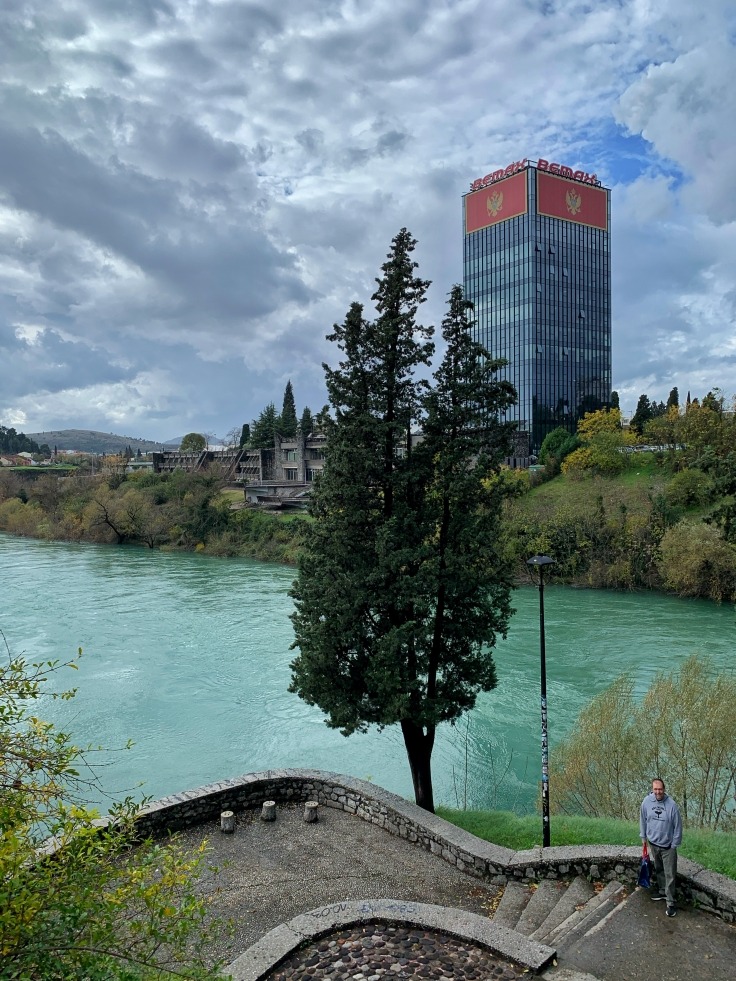
Considering relocating abroad and seeking true freedom and community? Here’s an inside look at the Montelibero Festival, where freedom seekers learn what it takes to build a life on their own terms. My clients, Sasha and Grant, and I were fortunate to attend the 2025 festival in Podgorica. As they relocate to Montenegro, it was a great opportunity to connect with like-minded individuals locally and nationally.
*Note: Some of these links are affiliate links, meaning that if you book through my link, I will make a small commission (at no extra cost to you).
The festival began with a traditional breakfast at Pod Volat, a local restaurant near the historic Clock Tower known for authentic cuisine and affordable prices. The atmosphere was lively, filled with conversation, the clink of coffee cups, and the aroma of fresh bread and smoky ćevapi grilling (a Balkan traditional meat kebab). Attendees included community members, speakers, and newcomers. Most breakfast guests were Russians who left Russia nearly four years ago due to the war. English served as the common language.

It is wonderful to speak with people from other nationalities about their views on Montenegro, their relocation experiences, and their stories of leaving their homelands. The range of cultures hold different viewpoints than those of North Americans. The Montelibero community has a libertarian mindset and also seeks freedom and a reduction in government overreach. Montelibero members see their shared values of liberty as basic building blocks of community. Their aim is to form a mini-society exemplifying these values.
Montelibero was founded by Ukrainian agorists, ex- and current members of the Libertarian Party of Russia. Russian-speaking residents from Ukraine, Russia, Belarus, and Kazakhstan currently make up much of the project; however, Montelibero is gaining the attention of more supporters from non-CIS countries (Commonwealth of Independent States), such as the UK, Lithuania, Israel, Montenegro, France, and India. (Free Cities Foundation, 2023)
Cultural Nuances
Splitting bills among groups at Montenegrin restaurants is nearly impossible, as servers often do not understand and may become annoyed. Typically, one person collects all the cash and pays in a single transaction. When dining as a group, appoint a ‘cash collector’ at the start and have everyone contribute their share before the bill arrives. Bringing enough cash and planning ahead saves time, maintains harmony, and helps you blend with local customs.
While tipping is not mandatory in Montenegro, rounding up the bill or leaving small change is appreciated in restaurants and cafes. Even a few coins or one to two euros show gratitude for good service.
When greeting someone, a firm handshake and a friendly “Dobar dan” (Good day) go a long way. Locals value respectful greetings and eye contact. Learning a few basic Montenegrin phrases shows respect and fosters warmer interactions.

Interesting Points We Learned During Breakfast
Many Russians are leaving Montenegro due to proposed changes to the residency law requiring business owners to hire two Montenegrins to qualify. This upset the nomadic and expat community, as many are solopreneurs without employees. This rush to leave was premature, however. As of January 2026, this policy has not passed, and businesses are not required to hire two Montenegrins.
For now, the process for obtaining residency as a solopreneur typically involves registering a company in Montenegro, often as a limited liability company, appointing yourself as executive director, and proving sufficient funds or stable income. You must open a local business bank account, register a business address, and secure necessary permits. Then, apply for a temporary residence permit as a company owner, which may require health insurance and proof of accommodation. This option remains accessible but requires monitoring for legal changes.
Starting January 1, 2027, company directors from non-EU countries who own more than 51% in a Montenegrin company must show proof that they have paid at least 5,000€ in taxes for the 12 months preceding their residency renewal date (all taxes combined incl. VAT, social security contributions, corporate income tax, etc). Proof of education is no longer required. Residency needs to be renewed in the following time window: 30 – 60 days before it expires. Residency programs can change rapidly, solidifying the importance of connecting with a professional to help you navigate the bureaucracy.
Joining the EU means more bureaucracy and higher living costs. It also means Brussels dictates policies. Montenegrins are independent, and a Big Brother relationship will not go well.
Brain drain may be an issue if Montenegro joins the EU, as youth pursue opportunities in more dynamic countries. The appeal of relocating to vibrant cities like Milan over Podgorica, often called Europe’s most boring capital, would be strong. EU membership would facilitate such moves through freedom of movement.
After over a month in Montenegro, it is clear the country has a long way to go before EU acceptance. In some ways, Montenegro resembles Mexico in the European context: relaxed rules, influential families shaping business and politics, stray dogs in the streets, and a cash-based economy. For example, apartments booked on Booking.com required cash only—no credit cards. This analogy highlights informality, independence, and entrepreneurial spirit rather than deeper parallels. It’s part of the country’s charm.
Highlights of Montelibero Festival 2025

There were multiple speakers during the two-day event presenting different avenues toward liberty. Here are four projects standing above the others for timely solutions:
Liberstad, Norway, and the Concept of Voluntaryism

The first presenter was Sondre Bjelläs, co-founder of Liberstad, an intentional community in Norway founded in 2017. He shared images of Liberstad, including future districts, inviting us to envision gardens, homes, and gathering spaces. His enthusiasm encouraged active participation in building a community from the ground up. The core message was clear: find your community, surround yourself with like-minded people, and grow stronger together.
Liberstad is built on the philosophy of Voluntaryism, which holds that all human interactions should be grounded in voluntary, mutually consensual agreements. The community founders ardently uphold the belief that Voluntaryism is the bedrock of a society characterized by freedom, peace, and prosperity, while regarding traditional governments as outdated. In practice, you see freedom and personal responsibility at work in the community’s operations. Amen to that concept.
Liberstad comprises 350 ha of land, divided into several parcels. The main area is subdivided into four districts: the central district (for restaurants, shops, and administrative buildings), the tourist district (for festivals and camping), the housing district, and the nature and recreational district. Liberstad aims to host festivals (e.g. Freedom Festival) and other events to become a hub for liberty-loving individuals. In late 2022, a 75-hectare plot of land was obtained through a land swap and will be developed into a second residential district. (Free Cities Foundation, 2023)
The Free Republic of Liberland

Thomas Walls, Minister of Foreign Affairs for Liberland, presented the country, claiming it is the world’s freest. However, Croatia poses a significant challenge. Liberland lies in a “no-man’s land” on the Danube River between Serbia and Croatia. Croatia opposes settlement on this land, which neither country claims. Tom’s candidness about the challenges facing this developing nation was refreshing.
People are allowed to visit ARK Village, where Tom lives on the Serbian side of Liberland, to see the project. Liberland is promoting tourism to the area, and there is a wellness resort and spa project in the works.
Every citizen of a country should have the right to secure life, liberty, and property for themselves and future generations. To live in harmony and benefit all those willing to take responsibility for the course of their lives. Liberland has declared such rights in its constitution and promises not to exercise government overreach that has been, and is being, enacted by many institutions today.
Language of Liberty Institute

Glenn Cripe, an American with long-term residency in Italy, presented on the Language of Liberty Institute. In 2006, Glenn founded the Language of Liberty Institute and has since been organizing Liberty Camps for young people from developing countries. These programs aim to unlock participants’ thinking and creative potential, equipping them to develop their abilities and find individual solutions to social problems.
Glenn said, “I am here to learn how it is done in Montelibero and how these lessons can be applied to our programs around the world.”
The Language of Liberty Institute organizes Liberty Camps (aka Liberty English Camps, or Liberty Entrepreneurship Camps) in developing countries, where they offer a unique combination of exploring classical liberal ideas in philosophy, history, economics, ethics, entrepreneurship, and the great thinkers. Workshops are conducted on how to apply these ideas to solving problems in daily life back home. Attendees also participate in discussions, debates, workshops, and presentations on these topics, thereby gaining more opportunities to practice speaking English.
Art Crew in Bar, Montenegro

Art Crew is a new space opening in Bar for nomads and expats to connect. Bar is a city located on the coast, southwest of Podgorica. Art Crew features an art studio and event space to foster a creative community. The venue will host coworking, workshops, events, lectures, club evenings, and festive markets. Interested individuals can check weekly open hours and drop by for a tour or coffee. Expats and newcomers are welcome at public events and workshops, with schedules posted on social media. A flexible membership program offers regular access to coworking and studio spaces. Joining is easy: visit during open hours or attend events.
Plans include a small cafe and bar. The goal is to build a community for connection, inspiration, and creative exchange for children and adults. There is immense potential for this to become the social community centre of Bar.
Freedom Abroad Isn’t Found. It’s Engineered.
New international connections and friends were made, and Sasha and Grant found themselves welcomed into circles to help make their transition smoother. These new relationships are not just social milestones; they are stepping stones for Sasha and Grant as they work toward building their lives here. As always, building community is at the heart of everything I do.

The Montelibero Festival is a reminder that the future of freedom may not come from large centralized systems, but from people building parallel structures, intentional communities, and alternative ways to live, work, and govern themselves. Around the world, more individuals are quietly voting with their feet, leaving behind heavy bureaucracy, rising living costs, and political systems no longer reflecting their values. Places like Montenegro are standing at a crossroads: between joining larger political unions with more regulation and preserving the independence that has defined their culture and way of life.
What is emerging is not only a relocation trend, but a freedom movement driven by people who want autonomy over their income, lifestyle, and future. Festivals like this are not just social events; they are blueprints for what a more decentralized, self-determined world could look like. For those who are willing to take the risk, the reward is not just a new country. It is the chance to help shape a new vision of how people can live freely, responsibly, and on their own terms.
Ready to Take the Next Steps?
Here is a simple checklist to start engineering your freedom abroad:
1. Research and connect: Find local or international communities and networks that share your values. Begin by joining relevant online forums and social media groups, or by attending events and meetups.
2. Plan your route: Look into visa requirements, residency options, and cost of living in your target countries. Prepare your documents and create a realistic timeline for your move.
3. Build your foundation: Strengthen your financial independence, develop remote work skills, or start a location-independent business. Ensure you have a support system and practical resources in place for a smooth transition.
4. Hire a relocation coach: Stop guessing. A relocation coach helps you avoid costly mistakes, cut through bureaucracy, clarify your motivations, and design a move to fit your long-term vision, not just your current frustration. The right coach will challenge your assumptions, pressure-test your plan, connect you to trusted resources, and help you think through residency strategy, community fit, and lifestyle alignment before you uproot your life. Freedom abroad isn’t found by winging it. It’s engineered through informed, intentional decisions.
If you want expert guidance in building your relocation strategy, this is exactly the work I do with clients inside my coaching programs. If you’re seriously considering relocating and want to do it strategically, not emotionally, not impulsively, then let’s talk. Book a complimentary 30-minute discovery call. We’ll assess where you are, what you’re aiming for, and whether your relocation plan is built on fantasy or a solid foundation. Freedom abroad isn’t found. It’s engineered. If you’re ready to engineer yours properly, I’m here to guide the process.
Taking these steps can turn inspiration into action and help you build a life of liberty and purpose, wherever you choose to call home.
Photos by Charlotte Tweed

Charlotte Tweed is a Certified Travel Coach with The Travel Coach Network, accredited by the International Coaching Federation (ICF), and founder of Liberty Travel Coach, where she guides pre-retired and retired women who reject globalist propaganda to find freedom and belonging with like-minded people overseas. Her transformational journey began with her first winter escape from Canada to Tennessee—a pivotal decision that sparked a deeper desire for change. She then launched into long-term travel, starting with visits to Egypt and Jordan, followed by a three-month overland trip from Rome to Amsterdam that changed the course of her life.
Today, Charlotte offers exclusive 1:1 coaching and hosts relocation travel retreats designed to help others overcome fear, gain clarity, and take actionable steps toward living abroad. With 22 countries explored and a background in tourism and expat life, she blends deep personal insight with practical guidance.
Serious about building a life abroad that aligns with your values? Download my free relocation guide and join A Case for Freedom Fridays, where I share practical strategies, on-the-ground insights, and real conversations about engineering freedom abroad.


References
Free Cities Foundation. (2023). Montelibero. Retrieved from Free Communities: https://free-communities.org/project/montelibero/
Free Cities Foundation. (2023). Liberstad. Retrieved from Free Communities: https://free-communities.org/project/liberstad/