Leaving a place always brings a mix of feelings. There’s the excitement of what comes next, but also a sense you’re not quite finished with where you are.
That’s the feeling Montenegro leaves you with.
*Note: Some of these links are affiliate links, meaning that if you book through my link, I will make a small commission (at no extra cost to you).
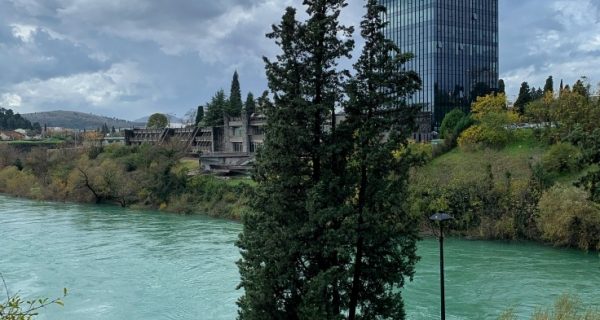
After spending just over a month in Montenegro, I saw a lot—Tivat, Budva, Kotor, Perast, and Podgorica. Each of these towns has its own distinct appeal: Tivat feels a bit more polished and focused on yachting, with sleek marinas and a modern vibe; Budva draws huge crowds in summer, full of nightlife and old town spectacle but always buzzing with tourists; Kotor is breathtaking, surrounded by ancient walls and dramatic bay scenery, though it often feels packed with cruise ship visitors. Podgorica is the capital of Montenegro, but it is lacklustre compared to other European capital cities, with little to see and do. Yet, it still feels like we’ve only scratched the surface of this small, complex country of towering mountains and nearly 300 kilometres of Adriatic coastline. Among the places we visited in Montenegro, Bar stood out as the most livable.
Why Bar Stands Out
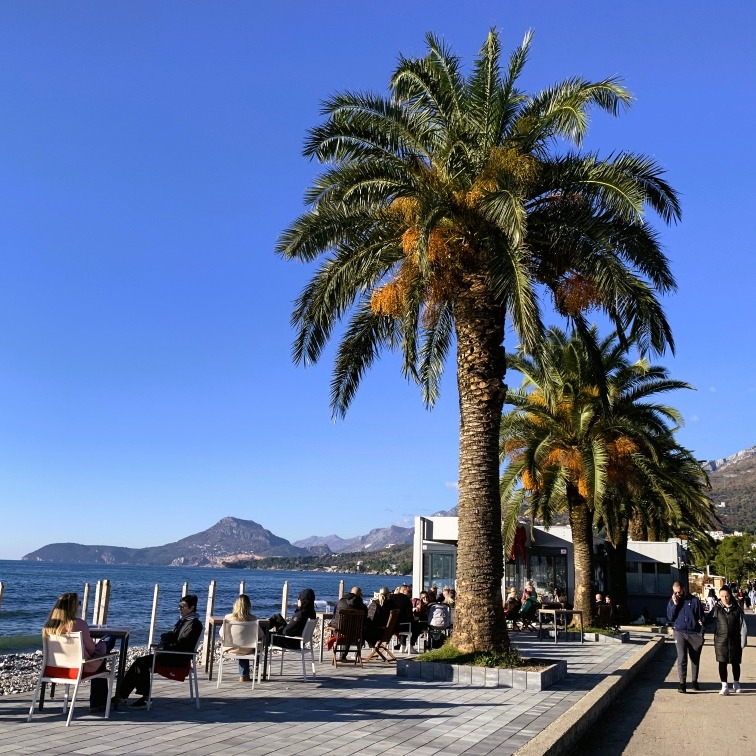
Bar has a grounded and real rhythm to it. On Sunday afternoons, the promenade comes alive. Families stroll along the sea. Children drive battery-powered cars up and down the walkway with surprising confidence—often better than the adults navigating actual vehicles. Parents and grandparents watch nearby, smiling. It’s not a manufactured charm. It’s everyday life where people are connected. The streets are safe, even at night. Women can walk alone and be safe.
Coffee Culture Without the Chaos

The promenade is lined with cafés and restaurants, but not in the overwhelming, overbuilt way you see in more tourist-heavy destinations. Nothing blocks the view of the sea. Instead, it draws you in. On one side, you have the Adriatic with gently lapping waves and the sound of rocks tumbling as the water rolls back out over the rocky beaches. On the other hand, the black mountains stretch to the sky, touched by clouds hovering over their rugged peaks of dark, dense forests.
You’ll catch the scent of freshly brewed coffee before anything else. Order a deutsch (their version of a cappuccino), and you’ll pay less than you would elsewhere, partly because you know how to pronounce it.
Affordable bakeries are everywhere. Burek (flaky pastry filled with cheese or meat), fresh bread, cakes, and sweets are all part of daily life here. Lunch for two can cost around €5. A loaf of fresh bread? About €0.80. It is the kind of place where you do not plan to visit multiple bakeries, but end up doing it anyway. For coffee, Nice Vice is a classic choice on the promenade, perfect for people-watching with a deutsch and a slice of the salty sea air, adding a little more flavour to everyday life.
Nature Up Close

Bar gives you something rare for a coastal town: space.
The mountains aren’t distant. You can reach out and touch them. Close enough to feel part of your daily environment, the town itself sits in an open valley, giving you room to breathe and listen with your eyes.
In winter, golden hour starts around 4:15 p.m., but the light lingers. The sun stretches across the Adriatic, casting warm tones across palm trees and mountains, making time slow down.
Everyday Living That Works

Bar is practical. The sidewalks are flat, clean, and walkable. Unlike places like Budva, you’re not constantly navigating steep inclines to get around.
At the same time, it’s a town in motion. Horns honk, construction tools hammer, birds sing, and children laugh. Life is happening all at once. Significant development is underway, with new apartment buildings going up throughout the area. It’s growing, but it still feels accessible.
For those looking at Europe as a lifestyle option, not just a vacation, Bar is worth considering. English is spoken, though not fluently. You could get by without the local language, but making the effort to learn it would go a long way.
Apartment Hunting in Bar
I did some apartment hunting in Bar with my clients, Sasha and Grant, who recently received residency in Montenegro.
We looked at a variety of apartments, but the ones featured in the video above are some of the best we saw in their price range.
Some insights to consider when hunting for a place to live in another country:
- What is required for a deposit? In Montenegro, the first and last month’s rent, along with a damage deposit, have been requested. This may be negotiable. If you plan to have a pet, the damage deposit may double.
- Having a pet in Montenegro is going to drastically reduce your options for rent. Many landlords do not want pets in their units.
- Are utilities included? If not, how much is electricity, gas, water, internet, etc? We have found that rentals in Montenegro do not include any utilities. Ask for a copy of previous utility bills, so you have a good idea of what you will be paying.
- Is parking available? If parking is available, is it included, or is it an additional charge? Parking in Bar is an issue, so if you plan to have a car, you need to know where you are going to park. Not all apartments include parking, and some only have street parking, which is a problem at this point. The city is implementing paid parking to help prevent people from parking their cars in spots on the street for extended periods of time. Some people leave their cars parked on the street for months as they country hop around the Balkans.
- Where do the owners live, and what are their rights to enter the apartment?
- Are there building rules? If so, get a copy so you know what is expected of you and your neighbours.
- Understand your rental contract. In Montenegro, your contract may say your rent is for €500, even if you agreed to €800. If you see this, it means €300 is due in cash to the landlord. The government charges a 15 percent tax on rent. Read between the lines.
Renting an apartment long-term in a foreign country comes with nuances. Come along with us as we search for Grant and Sasha’s new home in Bar. Watch the video here.
Finding Community Abroad

This is where Bar is surprising.
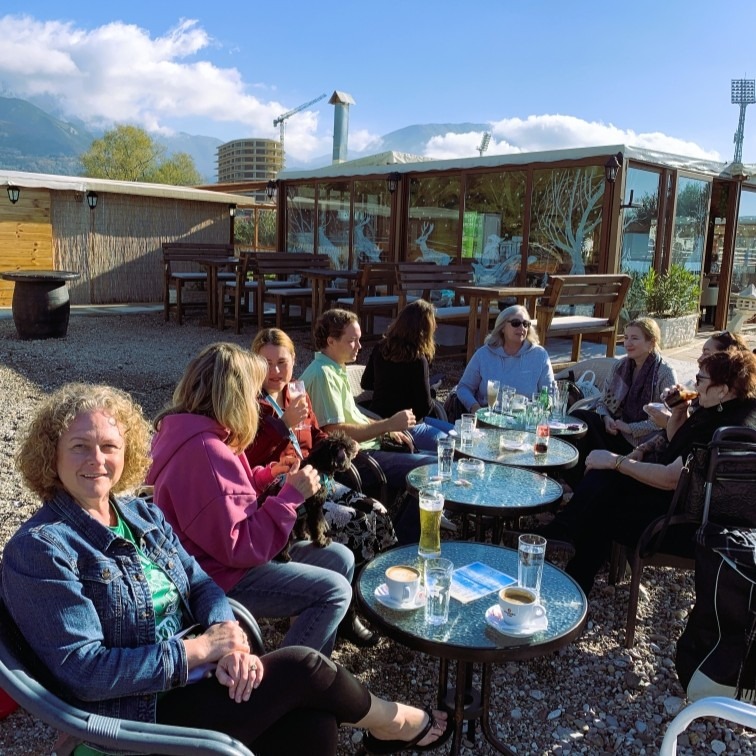
There’s a strong and growing expat presence. People from the U.S., Australia, the U.K., Mexico, and beyond all connect regularly through informal coffee groups and gatherings. These aren’t surface-level interactions. There’s depth to the conversations, a shared awareness of what’s happening in the world, and a desire to build something different.

One standout experience was visiting the Montenegro Tower in nearby Dobra Voda. It’s a renovation project led by Chris, a German expat, and it’s become a hub for connection, featuring game nights, jam sessions, events, and conversations bringing together people from all walks of life, including many who have relocated due to conflict. It’s been described as “the most English place in town,” but what it is… is a meeting point. In Bar, you don’t stay anonymous for long. Walks quickly turn into conversations. Familiar faces become part of your daily routine.
A Visible Past

Bar isn’t visually stunning in the way some European cities are. Much of the architecture reflects its past with Soviet-era apartment blocks and functional, sometimes stark buildings prioritizing utility over beauty.
But history is present here in an unusual way.
You’ll find remnants of ancient civilizations woven into everyday life. The ruins of a 6th-century church from the time of Emperor Justinian appear unexpectedly among modern buildings.

Then there’s Old Bar.

Perched on a steep cliff at the base of Mount Rumija, this fortified town of Old Bar tells the story of centuries of rule—Byzantine, Slavic, Venetian, Ottoman. Each left its mark. Only when the conflict subsided did the city shift from the cliffs down into the valley by the sea.
Even more recent history, like the impact of war on nearby Podgorica, is still visible in the way the region has been rebuilt.

The Final Days
As our time in Bar, Montenegro, winds down, the details feel sharper. Mid-December temperatures hover around 15°C (59°F)—sandals weather for this Canadian.
“Are you cold?” people ask.
“No. I’m Canadian.”
Usually, a knowing nod follows. One gentleman smiled and made the sign of the cross over his chest while pointing with the other hand at my exposed toes.
Locals bundle up in jackets and hats, while I walk along the promenade in open shoes. It’s a small but telling reminder of how perspective shapes experience. Christmas decorations are starting to appear—slowly, without urgency. A tree here, lights there, garlands going up one shop at a time.
There’s no rush.
Montenegro moves at its own pace.
Would I Live Here?
Yes.
It took time to arrive at a yes. I didn’t land here under ideal circumstances, and the first week was shaped by stress and medical concerns. But once the turmoil passed, a unique experience opened. Bar isn’t trying to impress you. It doesn’t overwhelm you with spectacle. It offers something quieter—something steady.
A place where life feels livable. Freedom abroad isn’t found. It’s engineered.
Until Next Time
Bar is a place I miss—not just for what it is, but for how it feels to be there. There is a sense of community where people watch out for one another. Where the expats are a part of each other’s lives. To catch you before you fall. If someone needs help, there is someone there to guide or even offer a ride to a nearby town. The critical idea behind community is alive and well. We’ve lost this sense of community in Canada. Everyone has a million things scheduled. How can you look out for your neighbour? You are lucky to get a family to sit down for a meal together, especially without their phones. Is this progress? You do not see people sitting in cafes on their phones, or children glued to their screens in Montenegro. You are part of people’s lives. There is an importance placed on family life. The strength of a nation is in direct proportion to the strength of its families. The family should always be a top priority. As you structure your life abroad, watch for how the location approaches the concept of family.
To the people who made Montenegro meaningful: God be with you ‘til we meet again.
Photos and video by Charlotte Tweed

Charlotte Tweed is a Certified Travel Coach with The Travel Coach Network, accredited by the International Coaching Federation (ICF), and founder of Liberty Travel Coach, where she guides pre-retired and retired people who reject globalist propaganda to find freedom and belonging with like-minded people overseas. Her transformational journey began with her first winter escape from Canada to Tennessee—a pivotal decision that sparked a deeper desire for change. She then launched into long-term travel, starting with visits to Egypt and Jordan, followed by a three-month overland trip from Rome to Amsterdam that changed the course of her life.
Today, Charlotte offers exclusive 1:1 coaching and hosts relocation travel retreats designed to help others overcome fear, gain clarity, and take actionable steps toward living abroad. With 22 countries explored and a background in tourism and expat life, she blends deep personal insight with practical guidance.
Serious about building a life abroad that aligns with your values? Download my free relocation guide and join A Case for Freedom Fridays, where I share practical strategies, on-the-ground insights, and real conversations about engineering freedom abroad.